
Ishimuni-san's Big Dance
A Tale from the Smoking Room

Deep within the cosmos sails a mysterious golden ship that has gone by many names. Some call her the H.M.S. Entropy. Others call her The Library of Diomedes, or The Golden Seraph. But most simply refer to her as “the Smoking Room.” In her halls men come and go, some staying longer than others, to do the work they’re meant to do.
These are the stories of what’s permitted for their salvation.
The day he finally blew up the bank began like every other.
Cold rice. Hard-boiled egg. Pineapple juice. The skittery trumpet of Terumasa Hino’s “Taro’s Mood” harassing his morning routine from the tape deck. The apartment windows foretold a facelessly overcast day ahead. He smoked a cigarette in a cold shower and then stood naked in his apartment, stalled. Getting dressed today was not part of the routine.
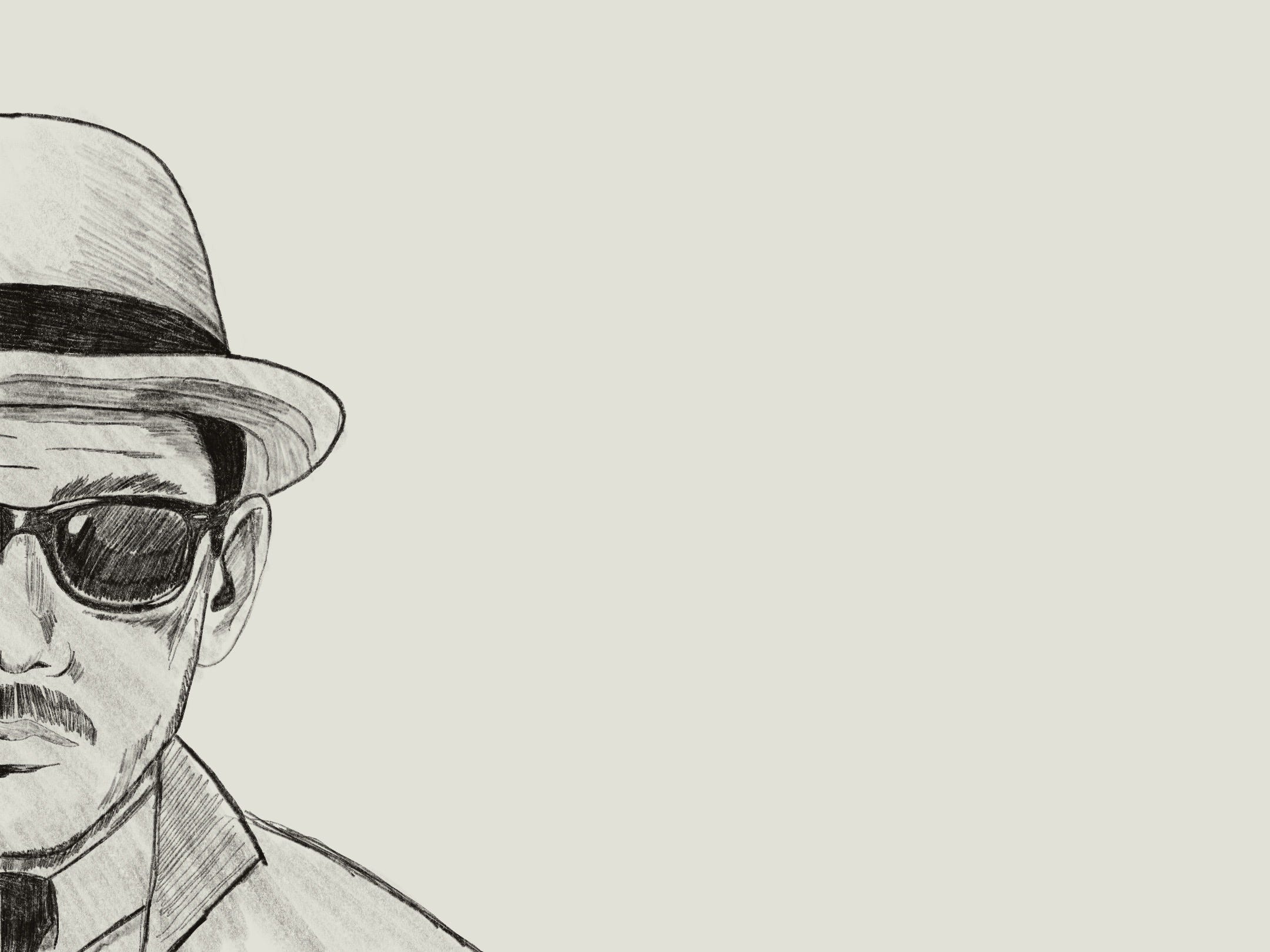
His outfit lay before him. It wasn’t his usual get-up, the coveralls and tennis shoes of a janitor. Today’s outfit was special. Today, he was going to dress like one of them. A banker. Not a high level guy. No one in charge. But someone who looked like they belonged? A professional? Sure. A pristine white collared shirt, grey dress pants, black suspenders, black tie, black wingtip shoes, a double-breasted grey trench coat that went past his knees, and a grey felt fedora with a black band– clean clothes for extreme cleaning.
Hino’s trumpet sputtered and crashed with a chattering snare drum as he stumbled into the broad pants. They billowed and swished about his legs in a way he didn’t care for, not like the tight coveralls, but their interior was silky soft and he could move freely. He snapped the suspenders down on his shoulders and fixed the tie, a simple clip-on, to his neck. Then he turned to the bomb harness.
It was a simple black backpack with a battery and circuit board inside, with two long, jointed metal rods that went down to a pair of metal shoes for his feet. They fit snugly around his wingtip shoes, and underneath them were a set of three narrow pressure plates: one for his toes, one for the outer edge of his foot, and one for the heel. Each pressure plate housed a remote switch that triggered with a satisfying click when he placed enough pressure on it with his foot. He ran the long metal rods underneath his billowy trousers and secured them to the bottom of the backpack, then stepped into the shoes with a ka-thunk.
Every piece secure, he moved into the center of his apartment floor and shuffled his feet with a simple tap-tap-tap. The switches on his shoes pressed and depressed with a satisfying click-clack. Encouraged, he tried another, more complex tap sequence, moving from the heel of his right foot to his left foot. Clackety-clack-clack-clack. He allowed himself a small smile. Clackety-clack, clackety-clack, clackety-clackety-clack. His shoulders bounced with rhythm, and he next tried to match his steps to the scattershot drum staccato coming from the stereo. Hino’s trumpet wailed and whimpered in and out. Ka-clackety-clack, Ka-clackety-clack– Yes! –Ka-clackety-clackety-clackety-clackety-clackety-clackety-clackety-clacket– He stumbled and caught himself. This was enough. Everything felt correct.
He returned to his bed and threw the trench coat over the backpack, buttoning it and tying the belt snugly around his waist. Grey from head to toe, he placed a pair of black sunglasses into one breast pocket, and a pair of portable cassette players with fuzzy orange headphones into each waist pocket. He then grabbed the hat and returned to the bathroom.
He splashed cold water on his face and looked at his short chevron mustache. He noticed a single hair out of place and snipped it with a pair of scissors, then took his measure in full. Some flint had begun to creep into his mustache and down his temples, but for the most part, he looked young for his forty-four years.
He studied each part of his face. Today was the end, the last routine. He looked at himself in his dark, auburn eyes and thought of the loose, buoyant feel of his tennis shoes strolling the bank floors at night. He thought of mopping the marble floors in Saitama-san’s top floor office after closing. He thought of cleaning the toilets, wiping the windows, replacing wastebin bags, sweeping aisles between the rows and rows of investment desks– one floor, two floors, three floors, four floors –always starting at the far left corner and working his way backward in a snake-like pattern. He wiped down the phones on each desk, swept their clutter into drawers, brushed the typewriters, put pens back in cups, and made sure each chair was uniformly pushed in. He emptied and rinsed ashtray after ashtray. He made sure the espresso station in the reception room on the international floor had both South American and Italian coffee. He made sure the flags for the American trading desks were always upright. He made sure the little pewter lids on the beer steins on the German desks were dusted and polished. He made sure each desk in the British section had a tin of shortbread for the week. He dusted the teller windows, polished the glass, and wiped down the windows on the main floor before leaving. He thought of coming home each night, just an hour before dawn, falling asleep until late morning, then beginning again with another round of hard-boiled eggs and pineapple juice. His face bore very few marks of this work.
Hino’s trumpet screamed in the background.
He thought of his errands. The home center on Monday and Thursday for materials and ingredients. The camera store on Wednesdays for RF fobs, wire, short wave antennae, diodes, or whatever else was necessary that week. The manager there, Haturu-san, had turned him on to a friend of his who built model train sets, and from this he learned much about remote triggers, switches, and sequencing. All of these things he tested and experimented with on Friday. On Saturdays and Sundays he went to Riku’s record store, ordering new tapes and attending tap class in the upstairs studio. There was no tap class, and no studio. He paid Riku to think otherwise so he could practice. Once a month, on the weekend, he went to a certain landfill in the country that had an unadvertised, cordoned section for military waste, and the trucks were left there overnight while the drivers saw to their mistresses or whatever else would justify leaving a military truck unsupervised at a landfill. He took whatever he could from these and adapted it for his use. There was no fat under his chin.
He thought of the early nights, alone in his apartment, mixing the compound, waiting for it to set and packing it into thermoses, before heading into work and applying it to the underside of a different desk each time. It looked like caulk, and no one had ever noticed it at the back and lateral joints under each desk. He thought of the early evenings where he spent hours and hours getting his tap-steps right and programming the switch sequence into each short-wave detonator, one at a time, hundreds of them, until they were all finished, then going back to the bank and fixing them in place. He thought about studying each unique tap combination in his notebook before bedtime in the early evening, memorizing each combination for each bomb in each place. The bags under his eyes attested to this.
He thought of the year where they remodeled and replaced all the desks on the fourth floor, and he called Saitama-san, posing as an antique dealer who was interested in the rest of the desks in his building. It was a stupid ruse, but enough to convince the banker that he was secretly sitting on top of an antique goldmine, and he refused to replace any more of the other furniture in the bank.
He thought about the year he spent re-doing that floor.
Night after night, week after week, month after month, he had patiently applied himself to his routine and rigged the entire bank to explode. The wrinkles on his forehead were only just barely noticeable.
He had followed these routines, until today, for twenty-two years.
Hino’s trumpet hit a shattering crescendo.
He straightened up, adjusting his tie and jacket to smooth out wrinkles and looked to the picture taped to the right side mirror frame. It was the last night he and Miyuki had been at the club together. He was twenty-one, clean shaven, hair slicked back in a large pompadour, wearing a blue sweater, sitting at his piano. She was on his lap, happy and smiling, wearing a black and white polka dot dress, clarinet tucked under her arm. He lifted the photo carefully off the frame, removed the tape from the back and tucked it into his breast pocket. He smoothed his mustache with his finger one last time, ejected Hino from the tape deck at the height of his racket, and left his apartment.
The walk to the bank was quiet at first. It had rained in the dark early morning and the sidewalks were wet. A sheet of white grey clouds hung over the city. People shuffled few and far between and the man kept his distance so as not to distract anyone with his sharp click-clacking, but soon, the bustle of the morning came on and there was no need to hide the sound of his shoes. He took his portable tape player out of his jacket and slotted the tape back in, finishing “Taro’s Mood” as he reached the office plaza where the bank loomed high. Green paned glass shone above the dismal courtyard dotted with trees in concrete planters. Large golden letters to the right of the bank’s main revolving door proclaimed [“GOLDEN CRANE INTERNATIONAL BANK.”] Armed security stood outside nodding to customers as they walked in.
He went right, down an alley and around the back to a service entrance. Kikashi-san wasn’t there yet, and there wasn’t a security guard at the back. Very little of this bank’s transactions were done in cash. All the money changed hands on paper and over the phone, and what money was moved typically did so in Switzerland, America, or Brazil. This was the future, he had been told. He let himself in with his service key and discreetly made his way to the second-to-top floor from the service stairs. This was the floor for the United States, Canada, and Great Britain. Many agents were already at their desks, taking phone calls and smoking cigarettes. He caught snatches of adequate English as he passed by. No one noticed him as he made his way to the main elevators to reach the top floor.
He emerged into a marble hallway with a large reception desk at the end. The receptionist was young, wearing a pink sleeveless sweater over a white shirt, hair dyed auburn.
[“Good morning!] She said, [“Are you here to see Mr. Saitama?”]
He nodded. [“Ishimuni. I am his 8 o’clock.”]
She rose and came to meet him. [“Will you take tea? Or coffee, perhaps?”]
[“I need nothing.”]
She bowed and gestured to the doors to Saitama-san’s office, a rich brown wood with an ornately decorated frosted glass oval in the center.
[“Mr. Saitama. Your 8 o’clock, Mr. Ishimuni, is here to see you.”]
Ishimuni entered to see Saitama’s back turned in his broad leather chair. He spun around, puffing on a cigar and motioned him in. [“Come on. Come on then! The day is young, but it burns!”]
Ishimuni didn’t acknowledge him. He looked around the office, the bongos of Hino’s “Predawn” popping in his headphones. Saitama’s decor was spare, but it radiated money. Black marble floors were bordered and separated with green marble trim. His desk was a massive frigate of cherry-stained mahogany, sitting before a pair of deep leather chairs. His windows extended from floor to ceiling along the three walls adjacent to his door. Taller buildings abutted on either side, but the windows behind Saitama’s desk allegedly afforded a clearer view of Tokyo beyond. A fog had settled over her skyscrapers this morning.
[“May I take your coat and glasses, sir?”] The secretary asked. Ishimuni held up a dismissive hand and she excused herself.
Saitama puffed on his cigar and regarded Ishimuni from the background. [“Well now, sharp fellow, I’m told this was an investment pitch.”] He released a billowing cloud of smoke, but the size of the room prevented it from doing much more than obscuring his face. [“Are you here to sell me a product or an idea? Let’s get on with it, I haven’t got all day!”]
Ishimuni paced to the windows, checking the panes where they joined to the floor and the ceiling, before turning back to Saitama’s desk and walking toward him. Saitama was considerably fatter than Ishimuni, and nearly a decade older, but they had the same slick hair and the same chevron mustache.
[“Silent type, huh?”] Saitama said with a cynical gaiety. [“I’ve seen all kinds. Fine. Get on with it.”]
Ishimuni came up to the edge of Saitama’s desk and looked at him through his dark sunglasses, just for a moment, and then turned his attention to a small picture frame on the desk. He picked it up and turned it over in his hand. There was a picture of Miyuki and Saitama, with their children. He had seen it many times while cleaning, but never held it in his hand or looked at it closely until now. She was indistinguishable from his memory, even all these years later. An electric charge ran up the back of his neck. He grew hot. His head buzzed like a whistling kettle. Hino’s trumpet amplified the whistling, rushing, building pressure, until–
[“Hey!”] Saitama pounded his fist on the desk.
Ishimuni snapped out of his fugue and looked at him.
[“Stop stalling and get on with it before I get bored!”]
Ishimuni made an obvious show of regaining his poise and then held the photograph up before Saitama. With a flourish of his hands, he made the picture frame vanish.
[“Oh, a magician, huh?”] Saitama raised an eyebrow and reached for the intercom on his desk. [“I don’t have time for this.’]
Ishimuni reached out his hands pleadingly and pointed to Saitama’s jacket, straining with his index fingers. Saitama looked up at him and leaned back. With a puzzled look, he reached into his jacket and withdrew the picture frame. He laughed. [“Alright.”]
Ishimuni reached out for the picture frame again, politely requesting it with his eyebrows.
[“I admit, I haven’t seen that one before.”] Saitama said, allowing him to take the photo again. [“I’ll give you five minutes.”]
Ishimuni accepted the photo with a bow and then made it disappear again with another elaborate flourish. It was now secreted inside his breast pocket with the photo from his mirror. He then removed his headphones and took out his portable tape player. These he offered in turn to Saitama, who accepted them and hit play at Ishimuni’s gesture. Saitama heard the bongos of “Predawn” thrumming. Cymbals crashed and Hino’s trumpet peppered them all. His face scrunched up in doubt once more.
Ishimuni stepped back into the broader marble of the office and flipped a switch under his coat at the base of the backpack. The battery within activated, and a pair of red lights on the outside of the harnesses over his shoes blinked red. He lifted his hands in an artful gesture, beckoning Saitama to watch, and began to tap.
Tap-tap-tap-clack with his left foot, shifting smoothly, tap-tap-tap-clack with his right foot. Saitama leaned in. Ishimuni’s shoulders began to bounce. He tapped again, lightly from foot to foot, the plates in his metal shoes clicking with the pressure. He spun in place, whipping the length of his grey coat around and leaping nimbly from one combination of taps into another, spreading his arms out in a swimming motion to maintain his balance and flow into ever more complicated steps.
Saitama tried to bounce as well and match his rhythm, but the music in his headphones was discordant, and the tempo did not match Ishimuni’s pleasant, childlike frenzy. Frustrated, he peeled the headphones off and started to question Ishimuni. [“Now hold on. How is–
But Ishimuni carried his routine to a rousing conclusion, ending with a thunderous triple-stomp Ka-clackety-CLACK-CLACK-CLACK!
Saitama’s desk erupted. The window behind him shattered and ballooned into a cloud of razor sharp glass. There had been a brief flash of fire, and where Saitama sat was now empty. Ishimuni froze in an awkward hunch, staring at the desk in slight disbelief. It had shifted forward a few inches, and the joint between the top and the front was badly cracked, but for the most part, the force of the explosion had gone in entirely the opposite direction. It had worked. Everything had worked. The charge, the detonator, the tap combination. Flawless.
Ishimuni let a noiseless laugh escape through his breath. He heard vague noises of concern coming through the wall behind him and realized it was the secretary. He let out another flourish of taps from his feet, ending with a stomp on his right that pressed all three pressure switches.
BOOM!
The secretary’s crying suddenly stopped.
Ishimuni was in it now. The final routine. Reaching into his right pocket, he retrieved a second tape player, placed the headphones over his ears, and pressed play. The stately, patient trombone and relaxed keyboards of Hiroshi Suzuki’s “Walk Tall” gently filled his ears. He flicked the switch on the backpack again, turning off the circuit board, and stepped into the hallway. The secretary’s departure was considerably messier than Saitama’s, but he took no time to dwell on this, making instead for the elevator to the top international floor below. It was time to bring down the giant.
He strode out of the elevator and beheld an ecosystem wholly unbothered by what had transpired above. Investors, agents, and analysts were now setting about their work, chattering loudly on their phones, interrupting each other, beckoning for papers, spilling coffee, lighting cigarettes, calling out taunts, crying in celebration, and slamming phones in disgust. The beehive of international banking hummed in the reflection of Ishimuni’s glasses, and he pondered where to start his attack. Back to front? Front to back?Left to right? Inside to outside?
He flipped the switch on the backpack again. His shoes blinked red. The mannered, businesslike trombone of Suzuki was now bubbling with a menacing bassline, a bassline he had been dancing to for three years now. Inside to outside, he decided.
He stepped forward, at the mouth of the middle row that ran through all the desks. There was enough distance that he was at risk of shrapnel, but he decided the risk was worth it. His survival was academic now. He quickly rattled off another tap combination with his feet, and a quartet of explosions on the corners of the top floor detonated all at once.
The entire building shuddered. Dust fell from the ceiling. This time, everyone noticed, and all business ground to a panicked halt.
[“What was that?!”]
[“What’s happening?!”]
[“Call security!”]
No one noticed as Ishimuni calmly moved down the aisle and began to tap. He sashayed and dragged his feet, cluttering and clacking a new sequence of taps. The bustle of bankers unwittingly enveloped his carefree dance into their ranks, then suddenly flew back in a hail of fraying flesh and torn clothing as the desks behind him began to explode. Ishimuni didn’t so much as flinch or lose a step. He reached out his arms in long, languid stretches and spun around slowly, his feet skittering and thumping like the legs of a marionette.
Everyone around him screamed. They fled for the elevators, they fled for the service staircase, and the most unfortunate ran for the windows, the rows of desks slowly exploding behind them, one by one, in a cascading wall of fire, papers, and debris. The last outer row had an extra line of explosive compound on the outer edge to destroy the windows. Those who fled to them were unwittingly trapped and sent through.
Ishimuni came to the end of the central aisle, switched off the backpack, and turned around to observe his work. He was bleeding from a small cut on his forehead, blood mixed with sweat, but most of the blasts had been directed away from him, and he lived to dance on another floor. Many could not say the same. Dust choked the entire room, and he couldn’t see much beyond the bodies that lay on the floor in front of him. The screams and shouts at the opposite end near the elevators were enough, though. He turned around again and headed for the service stairs.
The next floor was already in a full panic. He forced his way through a throng of people trying to escape down the service stairs. Many were still standing at their desks, trying to get phone calls out and reassuring their visitors that everything was okay. Ishimuni turned on the backpack, clacked his feet, and detonated another battery of charges on the floor above. This time, there was a massive impact that made the floor drop under everyone’s feet. The top floor had imploded. Renewed screams and making for the exits surged. Ishimuni began to dance once more.
Outside, in the office park plaza, people had begun to flood out of the bank. A crowd of shocked onlookers had amassed. Smoke was pouring out of the cavity of the top floor and all of the windows that lined the fifth floor. The people screamed and blanched in horror as windows on the floor below began to erupt in showers of glass and smoke, moving from the outside in.
The music in Ishimuni’s headphones drew towards the end of Suzuki’s “Walk Tall,” and he took a break from his dancing to catch his breath amid the mellow trombone. It made the carnage around him feel like a day at the park. The elevator rigging had sagged when the floors above collapsed. He blew charges planted at the top of the elevator, shutting it off to the escapees and sending the car careening to the bottom. The floor was now mostly empty but for a smattering of survivors crying around him. He lit a cigarette and picked up one of the phones on a nearby desk. Dead. He threw it down and sat on the desk, restlessly puffing on his cigarette until he heard sirens.
He rose and went to one of the blown out windows. Dozens of people gathered below had become hundreds, shouting and pointing. He withdrew, and noticed a young woman at his feet, leaning against the wall. She was covered in dust and cradling a limp and bloody arm. She cried, struggling to speak. Ishimuni knelt down and took off his sunglasses. He couldn’t tell if she even realized he was there. She whimpered, tears cutting furrows in the dust on her face. He placed a hand on her healthy elbow and gently squeezed. Finally she looked at him. [“What is happening?”]
Ishimuni took a drag from his cigarette. [“All of us are living in a dream.”] He said softly, exhaling the smoke. [“Playing someone else’s notes.”]
She didn’t seem to be paying attention.
He looked at her straight. [“I’m trying to wake up!”]
She looked up for just a moment. All he could see in her eyes was the dark shadow of his reflection.
He sighed, [“Almost,”] and rose to his feet. [“Do you want a cigarette?”]
She renewed her sobs.
[“Never mind then.”] He looked to the stairs. [“If you survive, play the notes you deal yourself.”]
He pressed play on his cassette deck and heard the aggressive piano and drums of “La Fiesta” by the Tohru Aizawa Quartet leap into his ears. He snapped his fingers and flew to the stairs. This would be a fine backing for the next three floors.
Outside in the plaza medical cars and police had begun to filter through the crowd. Those on the edges who had not been present in the bank had an easier time speaking to the police as they gathered on the scene. For a moment they thought they had arrived at the end of the bombing, and then the fresh windows of the third floor began to shatter. The crowd wailed collectively and began running for the streets and sidewalks that led away from the plaza. Police waved them on, calling for cover. Medics rushed forward to help those moving slowly. Explosions peppered the walls of the surrounding buildings like dice rattling in a cup.
Inside, Ishimuni thrilled to the music. His feet were a blur. He bounced, brushed, buffaloed, and bombershayed through the desks, always several steps ahead of the last explosion. He chugged, cramped, and dug his way through each combination in his head. His feet dialed the destruction of every object in the Golden Crane. Papers, pencils, ashtrays, typewriter keys, and splinters erupted all around him. The bombs fanned out from him like rows of corn catching fire. Another floor destroyed, he headed down to the next, waving his arms alongside the furious clarinet charging through “La Fiesta.”
The plaza was now empty. The crowds pushed and huddled at the edges, away from the bank. Police maintained a makeshift barrier, urging people to get away from the epicenter. No one seemed to notice a tall white man in a dark purple coat slipping through the people and walking calmly into the plaza towards the front door of the bank.
His blonde hair was brushed back into a neat forest of curls, and he strode to the bank straight and bold, unflinching as the bombs rattled out of the windows of the second floor. The top two floors of the bank had collapsed. He could just make out screams and cries billowing out with the smoke. He marched calmly into the main floor to see Ishimuni sliding and rolling off the balls of his feet into a crisp double-stamp. As he did so, the desks behind the teller windows blew up, and suddenly the air was awash with falling paper bills. The blonde man stuck his hands in his pockets and rolled back on his heels, waiting to be noticed.
Ishimuni turned. The rollicking piano in “La Fiesta” was locked in a triple-time waltz with the clarinet, and his shoulders hummed with blood and adrenaline. He could not remember if he had ever felt this good before. But when he turned and saw the man in the purple coat standing at the entrance, it startled him. Everything froze. He stumbled awkwardly. The money suddenly seemed to hang suspended in the air, and he felt a cold, draining gravity well up in his belly. The man began to walk toward him.
“Good morning, Ted.” He said in a plain British accent.
Ishimuni blinked. [“Who are you?”]
[“Oh, forgive me, where are my manners?”] The man returned in perfect Japanese. [“You don’t mind if I call you Ted, do you? My people tend to diminutize things.”] As he walked he took a gold pocket watch out of his vest and glanced at it without reaction. [“I’m sorry to meet you like this. I’ve had an eye on your case for some time and I was hopeful that you wouldn’t go through with it, but… alas.”]
Ishimuni took a step back. He wasn’t dreaming, the money really was hanging frozen in the air. Everything was suddenly silent. Was time at a standstill? He looked back at the man. [“Who are you?”]
The purple man stopped a few feet away from Ishimuni, granting him his space. [“You may call me Diomedes.”] His eyes were a dull green color, and they radiated patience. [“I believe you spoke of… playing the notes you deal yourself, was it?”] He looked askance from Ted and mumbled to himself. “Odd phrase, but I think I can meet it halfway.” Looking back, he continued. [“Well, Ted, I come from a place full of people who have played the notes they dealt themselves and found it… wanting.”]
Ishimuni said nothing, he simply stared, with his mouth closed, trying to process things.
[“I come from a place where you can learn to play something better. Something meaningful. Something that can…”] He gestured to the chaos all around them. [“Do better than this.”]
Ishimuni breathed.
The purple man went on. [“A man of your considerable intelligence and ingenuity and… what’s the word I want here… askesis? Well.”] He shook his head. [“It can’t end like this.”]
Ishimuni stayed silent. Sweat was pouring from his brow. The shallow cuts and abrasions that dotted his face burned, but he could manage nothing.
[“Very well.”] Diomedes sighed. [“Allow me to be more direct.”] He snapped his fingers with a flourish and suddenly the two pictures of Miyuki were in his hands. [“You see these?”]
Ishimuni gasped and pawed at his coat.
[“Look at me, Ted.”] He ordered. [“Take off your glasses.”]
Ishimuni did so. He stared at this… Diomedes… and felt a kind of metallic buzz running up and down his limbs. The green eyes suddenly took on a shine deep in their depths, as if he was seeing an emerald gem glint in a dark pool. It disappeared, and he peered closer, trying to see it again.
Diomedes spoke plainly. [“I am talking about a path to healing.”] He held out his right hand to Ishimuni. [“I am offering you freedom.”] He held up the pictures in his left. [“From this.”]
Ishimuni continued to stare, but quietly moved forward, one step, and then another, until he was close enough to accept Diomedes’ hand. Instead, however, he lunged forward and snatched the pictures from his hand.
Diomedes didn’t react. He looked to the ground and nodded slightly as Ishimuni shoved the pictures back in his coat.
Ishimuni backed up again, gathering his breath and thinking of something to say.
Diomedes held up his hand. [“Ted.”] His green eyes were soft once more. Patient. [“Do you want to play the piano again?”]
Unconsciously, Ishimuni’s eyes buzzed for a moment, red hot, and then welled with tears. He nodded.
[“Good. We do too.”]
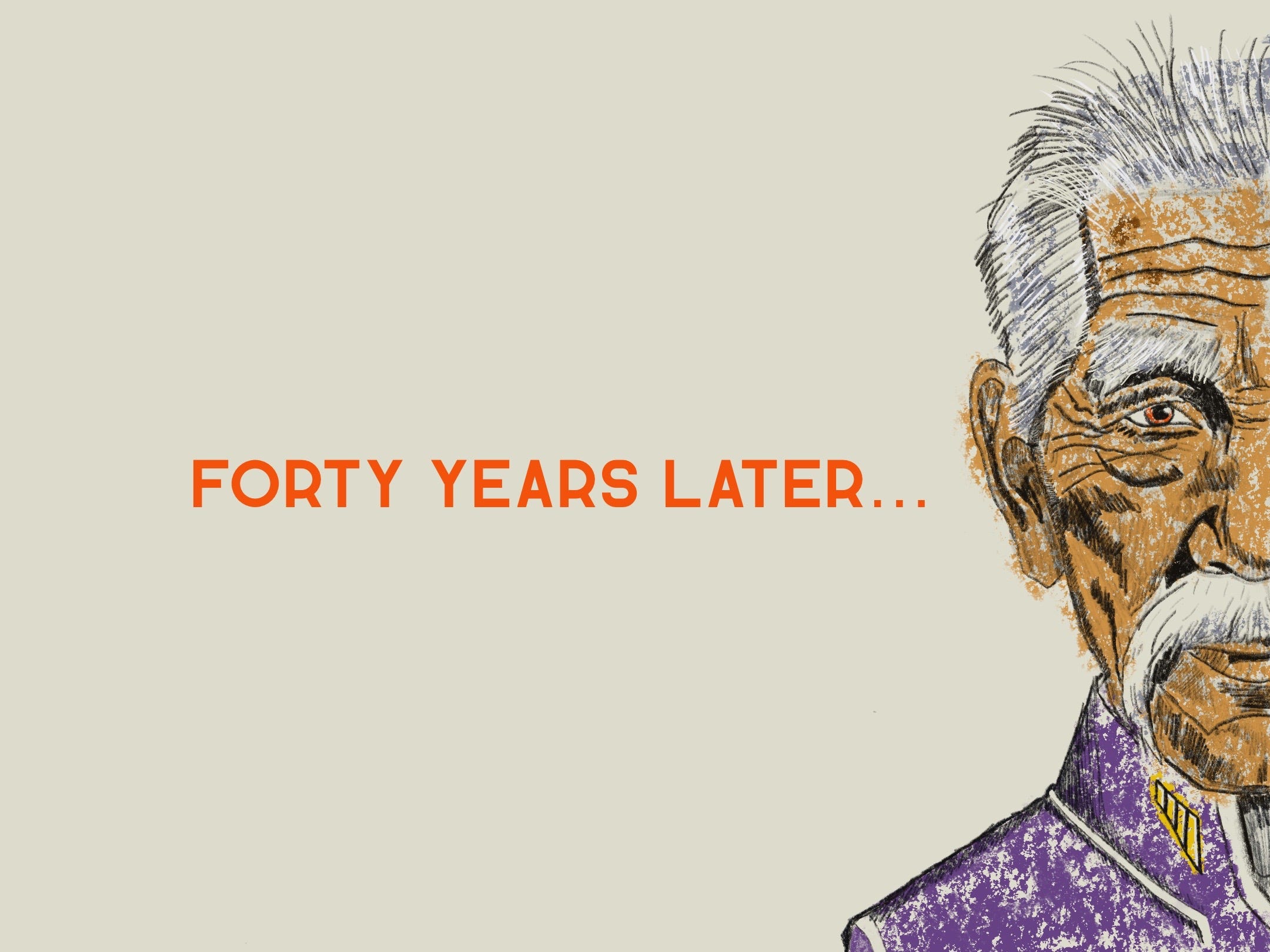
Ishimuni sat down at the piano, petitioning the men to quiet down with a wave of his hands. They refused, cheering and bellowing and quaffing their drinks. They called his name, shouting and cheering that he had agreed to play a song for them. He removed his white dress gloves from his hands and placed his bony, liver-spotted fingers down upon the keys, slowly playing the preamble to the Tohru Aizawa Quartet’s “La Fiesta.” It was a plaintive and soft opening that lured the listener in with a promise of tragedy and introspection. The men who had heard him play the song before cheered in recognition, enjoying the brief moment of silence before the tune shed its disguise and turned into a thriving romp of hard-charging keys and bustling rhythm. Ishimuni’s fingers danced and pounded with energy. Glen McGann, waiting for his cue on the drums, dropped in with a percussive snare, and the tune was off to the races. Everyone shouted and whooped in happiness.
The men of the Smoking Room crowded the bar, already well on their way to where it could take them.
“So, whose is the guy at the piano again?” Pvt. Sanborn slurred.
“The what?! Who’s that what?” T.P. Smethurst spewed beer from his mustache.
“The guy at the piano. He looks familiar. Everyone went crazy when he got his medal.”
Smethurst leaned close to Sanborn, trying to find some sign of intelligence or self-awareness in his eyes. “You don’t know the man at the piano?” He asked incredulously. “You don’t know Ted Ishimuni?”
Sanborn shook his head, his gaze wandering. “I mean, he looks familiar.”
“You don’t know the Jazz Bomber?” Smethurst pressed. Sanborn turned back to his drink and shook his head. The swarthy Englishman’s voice grew more firm by the question. “You don’t know the Thread of the Hellespont? The man who reclaimed fourteen stars? The man who tricked Xintchnil the Bepussed into eating his own sun?”
Sanborn looked at him blearily. “Dude, what?”
“The man who saved the Makrenine fleet at Algrebin? None of this rings a bell?”
Sanborn’s mouth dropped open, trying to salvage his face. “I mean, I’m always asleep whenever he’s is on the ship.”
Smethurst stared at him, eyes rocking back and forth like a rowboat on the open sea. He studied Sanborn’s face as closely as he could before determining that he must be speaking the truth, and then broke into a searing, cacophonous laugh. Sanborn took a second to catch up and then joined him. Both guffawed hysterically into the bar and shoved each other back and forth.
“LANDLORD! LANDLORD, I SAY!” Smethurst bellowed down the bar, gesturing to himself and the young soldier. “Neither of us are squiffy enough for this. Please assist!”
Ted was alight on the piano. His fingers bounced and flitted gaily. He closed his eyes and rocked forward and back, feeling the music from the tips of his toes to the tips of his ears. His white hair belied his agility, every note fell into place like nails falling on a magnet. The song was nearly ten minutes long, and he kept pace with an ease and an eagerness that he hadn’t felt in some time. The other men playing, Glen on the drums and Rex at the trumpet, danced and moved merrily, throwing themselves into the song with him. When it finished, Ted threw his hands into the air and shouted with the party. As everyone clapped and cheered he turned to see Pimm smiling over his shoulder. Ishimuni nodded at him. It was time to go.
The rangy, mustachioed Brit helped his elderly friend down to the Raven’s Nest where Phoughge was waiting, all business. The lights in the cargo bay were off, and they could only just hear the signs of the celebration above. On the platform was a pair of duffel bags and the thin frame of–
“A Kairos gate?” Pimm said, surprised. “How many palms did you grease for this?”
Ishimuni stepped carefully up to the platform using his tall cane and scoffed, clearing out his gruff, heavily accented voice. “You think I have to grease palms for such a favor?”
Pimm joined him and rested his hands on his hips. “Ha. I suppose not. A great deal of smoke, I wager, though.”
“You wager correctly.” Phoughge said, stepping over from his instrument panel and passing each man a set of earpieces and a pod for their Kairos belts. “DNA please.”
Both men fixed the earpieces in their ears and took the pods in hand, placing the left end of them in their mouths and exhaling into a pair of holes on the end. A ready light flashed blue on each.
“DNA looks good.” Phoughge said and passed them their belts. These they threw around their waists over their clothes and bound tight, taking the pods and slotting them into snug holsters on the front.
“Your destination is Tokyo, Japan, September 27th, 1979.” Phoughge continued. “You will be present for thirty minutes. Confirm?”
Both men looked to see the timer on the belt pod blink 30:00 and gave him a thumbs up.
“Mission?” said Pimm.
“I’ll leave the details to the good Bomber.” Phoughge replied, handing one duffel bag to Pimm and the other to Ishimuni. Pimm slumped at the unexpected weight dropped into his hands. “Don’t open that here.” Phoughge ordered. “And do everything that man says, to the letter.”
Pimm furrowed. “Is everything alright?”
“It’ll be fine,” Phoughge said, pressing his panel and activating the gate, which opened up to a cloudy city street on the other side. “In and out. Ready?”
“Ready.” Pimm gave him a thumbs up.
“Percipe et Face, old boys.” Phoughge said, touching his forehead and his heart.
“Percipe et Face, old man!” Pimm teased, and charged through the Kairos gate.
Ishimuni did not follow him immediately. He simply looked at Phoughge. Both men’s faces were neutral and calm. They stared at each other in silence for several seconds, until finally Ted reached for the front of his dress jacket, removed the array of medals pinned to it, and tossed them over to Phoughge. He smiled, ever so slightly, and growled in his Japanese timbre, “How do you track a man across the vacuum?”
“You study his heart.” Phoughge replied.
Ted nodded. “Now you don’t have to.” He paused one more time. “See you soon.” And left.
Phoughge stood there in the silence and darkness of the Raven’s Nest for a moment. “You know you saw him there, you old goat.” He mumbled to himself. “You know you did.”
Ted and Pimm emerged in an alleyway to see a broader street with people running and shouting to their right. Tumult was in the air, police sirens wailed in the distance, and a palpable sense of agitation surrounded both men. The timers on their belts began to count down.
“Right, Ted, you know more than me, but this seems a tad fraught already.”
Explosions cracked in the distance, and Pimm whipped in their direction.
“Ah, very fraught. What have we gotten ourselves into, old bean?”
Ted took a pair of sunglasses out of his pocket and looked up into the overcast sky, studying it for a quiet moment. He scanned the air above him, slowly, looking in all four directions, before looking down just as Pimm was about to prod him for an answer. “Our destination is very close,” he said. “Follow me, Pimm.”
They made their way to the edge of the alleyway and looked left. The rear of the bank loomed large over the smaller building directly behind it. The top two floors were caved in, windows were blown out everywhere, and dark grey smoke poured into the air above.
“Merlin’s beard!” Pimm exclaimed.
Ted moved in front of him and placed a hand on his chest. Pimm looked down at him, surprised. Ted looked him in the eyes. “Listen to me very carefully. We are here today to right a terrible wrong. A bomber has destroyed this bank. You must know: that bomber was me.”
Pimm blinked. “W-what?” Screams echoed across the tops of the buildings. People gathered in the street away from them, pointing and crying out at the scene.
“I came to the Smoking Room a broken man.” Ishimuni continued. “I have learned much. I have done much. I have grown old, and now, I hope to undo the pain I once caused. Do you understand?”
Pimm looked up, taking in the destruction above him. “I… You did this?”
“Yes, Pimm. I did.” Ted’s voice was firm. “In a moment, Phoughge will arrive to take me away. When that happens, we must act quickly to save this place. I can’t do it without you. This is the mission.” He repeated for emphasis: “Do you understand?”
Pimm breathed deeply, squinting ahead. “These people are innocents. You targeted innocent people? You never told anyone?”
“I did. This is an opportunity to undo the work of the man I once was. Will you help me, Pimm?”
Above them, the billowing black columns of smoke ground to a halt. The air grew silent. People froze in place. Everything hung still in the air.
“Phoughge has arrived.” Ishimuni said, a thankful grin playing on his face. “We must hurry.”
Pimm nodded, quickly processing his thoughts. “Right.” His nod grew vigorous, meeting Ted’s eyes. “Right ho, Ted. Let’s to it!”
Both men turned and ran towards the rear entrance of the bank. Ted pointed out the service entrance with his cane. “Through there!” he cried, old legs wiggling underneath his hunching back. They made it into the service hallway, and Ishimuni trundled forward to find the entrance to the bank’s main floor. “Wait here, I’ll make sure the coast is clear.” He told Pimm.
He cracked the door behind the teller windows just an inch or two and saw Phoughge talking to his younger self. He shrunk back, shutting the door. He knew that if he made eye contact with the younger Ted the whole mission would go up in smoke. He waited, counting, searching his memory. He had no recollection of seeing himself at this moment. It would be fine. He slowly opened the door again, cautiously peering through. Now Phoughge was there, alone, and the younger Ted had disappeared. The white light of the service hallway caught Phoughge’s eye and he looked instinctively toward Ted. Their eyes met for just a moment. The hairs on Ted’s neck stood on end, worried he had made a mistake. Instead, Phoughge’s face broke into a wide and savage grin, the likes of which Ted had never seen him make before. He looked wild, almost feral, like a moonshiner who had trapped a lawman in a mineshaft, but only for a moment, and then he vanished into thin air.
Ishimuni opened the door wide and stood up straight. The money and debris that hung in the air suddenly resumed fluttering and falling to the floor. What exactly had happened in that moment he was not sure. But the minutes were ticking and he had no time to dwell. “Come, Pimm. It is clear.”
They came to the center of the main bank floor and set down their duffel bags. Ishimuni knelt down and opened his, producing two pairs of tap shoes. “Put these on,” he instructed.
“I say,” Pimm marveled. “I cannot wait to hear this plan.”
Ishimuni took hold of the second duffel bag and unzipped it carefully, revealing a large canister that resembled a beer keg.
“A Gelwa bomb?!” Pimm sang.
“A Gelwa bomb.” Ishimuni nodded. “We will reverse the flow of time.”
“How in blazes did you clear that?”
Ted began preparing the device. “When you have done what I have done, you simply ask.”
Pimm looked down at his belt timer. “We’ve only been here for four minutes. How do you plan to call it backwards?”
Ishimuni did not look up from his preparations. “When I detonated these bombs I used a special harness fixed to my feet. I had switches embedded in my shoes that would trigger a detonator when tapped in the correct combination. When I danced, the bombs went off.”
“I see. So this…”
“This is where I became the Jazz Bomber.” Ishimuni said. “I did not know it until Phoughge let me study historical records of this. That was the nickname the press gave me.”
“I say.” Pimm shook his head. “It’s quite a romp you’ve had. But you didn’t answer my question!”
“It’s very simple.” Ted said, rising to his feet. “We are going to recreate my dance in reverse, which will echo the steps in the air and call the Gelwa backwards, bringing everything back together.”
Pimm grinned. He knew the Gelwa’s behavior better than anyone. “That sounds like an ace, Ted. Surely you didn’t need me to tell you if it will work or not.”
“No.” Ted answered, lifting his hands up and stretching. “I need you here because I am too old to do all the steps myself, and you are the only one who ever paid attention when I taught people to tap dance. So, you’re going to do them with me”
Pimm coughed with delight. “You’re serious?”
“Quite serious.”
“You want me to tap dance with you so that a Gelwa cloud will reverse all the damage done by a bunch of bombs you set off in a bank?”
“That is correct.”
Pimm could barely contain his glee, scoffing and well-I-never’ing to himself while Ishimuni stretched out all of his joints.
“Are you ashamed of this assignment, Pimm?”
Pimm caught himself. “Hardly!”
“Good!” Ishimuni stretched his arms out wide. “Then help an old man have one last dance.”
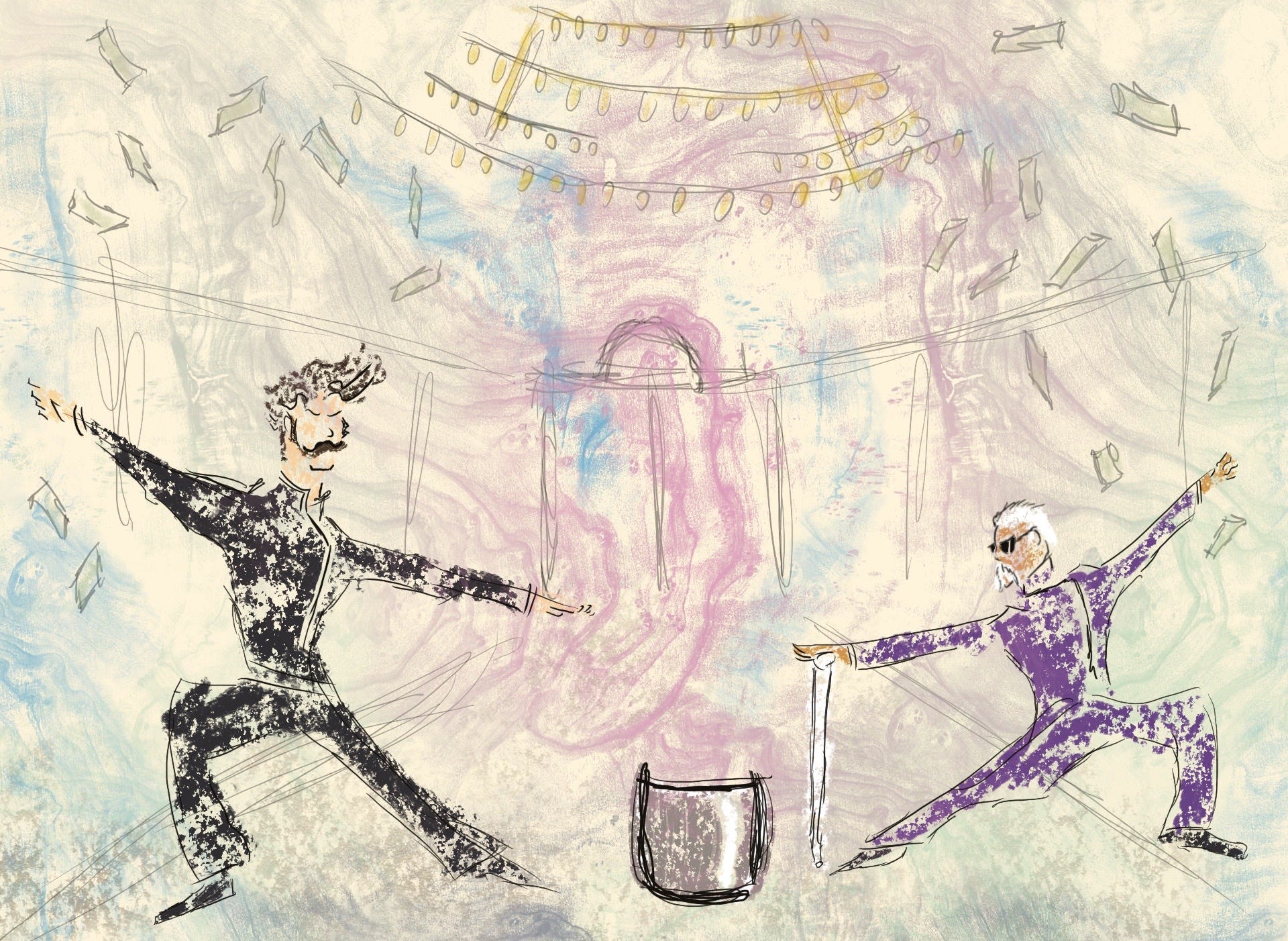
He tapped his cane twice on the floor and the top of the Gelwa bomb whisked open, shooting thick, iridescent smoke high into the air. In seconds, the room was suffuse with the light, ethereal mists of Korogbo. Ted beckoned Pimm to follow his movements and pressed play on his earpiece. A light and gentle harp began to pluck and trill an old melody in both of their ears. Ted lunged deep, away from Pimm, who matched him. They tilted their torsos back over their outstretched legs, each reaching toward the other.
“What is this song?” Pimm asked.
“This is called ‘I Could Have Danced All Night’.” Ishimuni said. “By Tadao Hayashi. An old favorite of mine. Now, follow me.”
A light snare drum kicked in to match the plucky harp and the old man jumped up, making a sharp one-two as his feet came down. Pimm followed suit, looking carefully to mimic the old man’s movements. And Ishimuni, who had dreamed of this day even longer than the first time he lived it, now began to dance his destructive dance in reverse.
After a few seconds, the money that littered the ground around them began to stir. Dust that had settled on the floor vibrated and leapt up. The air refilled itself with the disorder of the prior hour and began to put itself back in place. The dust retreated into seams in the ceiling and cracks in the walls. Money retumbled itself back into tight bundles underneath the counter. Splinters and pieces of glass found each other again amidst the Gelwa cloud and reformed their civilized barriers.
“Now the elevator.” Ishimuni said. He tapped his feet obviously and deliberately so that Pimm could easily follow. Their combined steps produced a groaning sound from deep within the building as the inner workings of the elevator pulled themselves back into place and resettled. The doors opened, pulling the Gelwa cloud in and inviting them to the next floor.
Here, in the first investment office, the wreckage was terrible, and the cries of the injured surrounded them, but Ishimuni remembered exactly how he had set himself to its end, and allowed himself to twirl as he undid his terrible work. The Gelwa crept through the room with him, claiming every last cell for its movement. Blood was pulled from carpets. Shrapnel was pulled from bodies. Limbs and flesh were knit back in place. Pain fled from those who were suffering. Ishimuni danced and Pimm followed. His joy was real in the lightness of his feet and the buoyancy of his elderly frame. People began to stand up, staring in disbelief as he passed by, and the harp sang in his ears.
Pimm was no longer shuffling and trying to keep up with him now. He recognized many of the tap patterns Ishimuni had taught him in class and could now follow him by ear. He thought of these tap routines. He thought of all their time shared on the Smoking Room. He thought of the first time they met after Phoughge’s return, hearing him at the piano for the first time, playing Debussy and Chopin with ease before shifting to a type of music Pimm had never heard before, but later discovered to be jazz. He thought about dance class in the cargo bay and how it had passed so much time for them during the Algrebin siege. He thought about their time on Makrino, waiting for Ted to finish attending liturgy before they went cloud sailing. He thought about their first job together, when Ishimuni saved him from a solar storm over Tynaschke IV. He thought about the attempted court-martial afterward and what a farce that was. And now here that man was, Pimm thought, an old man in his Makrinine dress uniform, tap-dancing through a building that he had destroyed many lifetimes before.
Glass returned to the windows. Desks shunted and collapsed back together. Ishimuni smiled as he tapped, looking back at the young man who had been his pupil at various times over the years. He thought about how offended Pimm was the first time he played jazz for him. He thought about all the annoying pranks Pimm had played in tap class during the Algrebin siege. He thought about how Pimm always skipped liturgy on the days they went cloud sailing. He thought about the solar storm Pimm had caused over Tynaschke IV and how long it took to convince Commander Grisk not to court-martial him. And now here he was, an old pupil but still in the bloom of youth, reading his steps and mimicking them almost perfectly. They could have danced all night indeed.
On the third floor, that song ended and a new one began, this time with a crisp, double-tapping cowbell percussing in the background. Ishimuni double-tapped in time, clip-clopping on his toes, and Pimm followed suit.
“What’s the one thing I have always told you is true no matter where or when you are in the cosmos?” He called back to Pimm.
Pimm recognized the bait question immediately and replied, “Masayoshi Takanaka is the man!”
“Masayoshi Takanaka is the maaaaaaaaaaan!” Ishimuni crowed, waving his arms from side to side as a smooth, chipper guitar joined the cowbell.
They moved in sync now, and both the third floor’s residents and residence began to reset themselves.
“Let’s see what you remember, boy!” Ishimuni called. “Dig!”
Pimm dug.
“Cramp!”
Pimm cramped.
“Chug!”
Pimm chugged.
He pointed with his cane. “Bombershay!”
Pimm bombershayed.
“Buffalooooo!”
Pimm buffaloed.
Both men laughed, bounced, and slid their way through the third-floor aisles. The pieces of the desks around them seemed to bob in time with the cowbell. Suddenly, everything dipped down and then jumped into the air again. Outside, the people marveled in disbelief. There was a soft light glowing from within the bank, the windows on the lower floors had put themselves back together, the fifth floor had un-collapsed, and the smoke seemed to be moving in reverse.
They came to the fourth floor, moving in exuberance, and Ishimuni danced his way to the young woman with the broken arm he had spoken to all these years before. The dust had left her face, her hair was clean once more, and her arm restored. Tears moved back and forth down her cheeks as she unprocessed and reprocessed what was happening around her.
Ted knelt down gently and removed his glasses. He bowed his head to her and said. [“Please forgive the man you met earlier.”] He reached into his pocket and took out a small, folded piece of paper. [“You should know that he eventually woke up, and learned to play something better.”] He handed her the note. [“Here. This will show you where.”] She accepted it, almost petrified
He stood and bowed his head once more. [“Forgive me.”] Then turned with a light pirouette and clacked his way back to Pimm.
“Back to the elevator, Pimm!” He called. “Our work is nearly done!”
They came, finally, to the top floor and the marble hallway that led to Saitama-san’s office. Ted stopped the music, and clacked his toes simply, holding up a hand for Pimm not to copy him. The secretary’s desk reformed with a whoosh and suddenly, the secretary herself was sat back in her chair, head slumped to the side, her face serene and her body still, as if sleeping.
“Check her please, Pimm.” Ted requested.
Pimm flew over to her and checked her eyes and pulse. “She’s dead.”
Ishimuni’s shoulders slumped. “I feared so. Those who died instantly cannot be rescued.”
Pimm rose and walked back to him. “It’s true. The Gelwa can reverse many things, but it cannot bring the dead back to life.”
Ishimuni breathed deep and closed his eyes. “Very well.” He looked to Pimm. “Stomp your feet three times.”
Pimm stomped. There was a groaning and cracking noise from the next room over. Ishimuni tried the door handle and it swung open silently. They entered Saitama-san’s office to find the portly banker fully intact but dead in his chair. Ishimuni approached the desk and plaintively removed a pair of photos from the inside of his jacket. He placed these on the massive desk and bowed his head. [“Forgive me, Saitama.”] He closed his eyes. His face quivered. [“Forgive me… Miyuki.”]
In a moment, he composed himself and looked back to Pimm. “Our task is accomplished.”
Pimm smiled. “Some day, wasn’t it?”
“It is.” Ishimuni replied. “It is.”
Pimm placed his hands behind his back and stretched. “Well, it’s a shame we can’t stay longer. I’d have loved for you to show me around the old place. I suppose we’ve enough time to retrieve the canister and then we can-”
Ishimuni wasn’t listening. He pulled the pod from his belt, waved it through the shimmering Gelwa air, and placed the end in his mouth, inhaling sharply. It reversed. The timer, now less than five minutes, suddenly blinked and went dead. Ishimuni then raised the pod high in his hand, took a vigorous breath, and smashed it to pieces on Saitama-san’s desk.
Mid-sentence, Pimm’s face suddenly went white as a sheet. The air vanished from the room. The Englishman’s mouth hung open, startled out of his thoughts, staring at the shattered Kairos pod. Ishimuni turned to look at him.
The young man’s stunned face nearly broke the old man’s heart.
“What… What are you doing Ted?”
“I’m sorry, Pimm.” The air grew thick and sickly with his words. “I’m not going back.”
“Wh- why–”
“Our task is accomplished, but mine is not. I’m going to turn myself in and answer for my crimes.”
Pimm’s eyes started to blur with tears. “Crimes? No, Ted. What? What are you doing?!”
Ted placed his cane on the desk. “I am doing what must be done. I am doing what I have been preparing to do for the last forty years.”
“Ted… No!” Pimm ran his hands through his hair. “We can fix this. I’ll fix it! I- I’ll get pulled back and I’ll convince Phoughge and Grisk to send a retrieval team. You belong on the ship! Your place is on the Smoking Room!”
Ishimuni nodded and smiled as gently as he could for Pimm. “It was. It was for a long time. But everything in life comes to an end, and it’s time for me to do the last thing I need to do.”
Pimm stared at the fragments of his belt pod, tears welling and mind racing.
“It is time for my repentance.” Ted said quietly.
Pimm’s eyes snapped back to him, and he stared, struggling not to sob. “Why?” He whispered. “You’ve done more for this planet than anyone who’s ever breathed its air! You’ve done more for these people here and everywhere else in time than anyone could ever possibly understand! Whatever made you do this in the first place, whatever happened, you- you have redeemed yourself! Many times over! What do you possibly have to repent of?!”
Ishimuni straightened up, looking suddenly formidable in his dress uniform. “Has Phoughge told you the story of Theodore yet? The General?”
Pimm sputtered. “Yes. I have heard his fairy tales many times.”
“They are not fairy tales!” Ishimuni roared. Pimm’s eyes went wide in shock. “You of all people should know that.” The old man hardened his look. “If you know the story, then tell me, what was the last thing he did before he died?”
Pimm looked down and shook his head, trying to piece the details together. “He… he baptized his captors and then turned himself back in to the emperor to be martyred.”
“That’s correct.” Ishimuni said, relaxing. “No one is mighty enough to escape the cross. We must learn to run to it.”
“Ted, no!” Pimm struggled. “What in blazes are you talking about? No one is trying to martyr you!”
“No one is trying to martyr me,” Ishimuni replied, “because I didn’t baptize anyone.” He paused. “I killed eighty-two people and injured hundreds more.”
Pimm huffed and threw his hands around. “Then what did we all just do?!”
“We saved many people’s lives, yes. We undid their injuries. But there are still plenty of the dead, and this is the only place where I may be held to account for it. I tell you, Pimm: truly, everything I have done since Phoughge took me in has led me to this moment. I have never wanted anything more.”
“Dash it all, Ted, you’re a war hero! A WAR HERO!” Pimm stepped away, looking out into the grey Tokyo skyline. He placed his hands at his hips and closed his eyes, gathering himself with many deep breaths. Finally, he looked down at the pod on his belt. Less than two minutes to go. He turned back around.
“I’m sorry, Pimm.” Ted said. “I’m sorry to hurt you like this. But it was the only way we could have a real farewell.”
This was too much for Pimm. He stepped forward and embraced the old man, tears pouring from his face. They hugged for a considerable time. Ted squeezed his shoulder and patted him on the back. When Pimm finally let go and stood up, Ishimuni pulled the sunglasses out of his pocket and placed them in his hand.
“When you return, go back to the cathedral on Makrino and put these on. You will see me.”
Pimm sniffed and nodded, gathering himself. “How are you even going to explain all this?”
Ted shrugged. “I’ll tell them the truth. Then they’ll think of something.”
Pimm scoffed. “Whatever they come up with, I’m sure they’ll hang you for it.”
“They may. If so, I accept it.”
Pimm offered him his hand, Ishimuni took it. “If not, what else will you do?”
Ishimuni stroked his long mustache. “I don’t know.” He looked askance. “I had a brother… once. He wanted to be a TV star. Maybe I can contact him.”
“As an old man?” Pimm said with an arched eyebrow.
Ishimuni laughed, his head bobbing. “Yes. What a surprise that would be.”
Pimm looked down at his belt. “Ten seconds.” He said. He straightened up, wiped his eyes and looked at Ted full in the face.
“It was an honor, Ishimuni-san.”
“Yes it was, dear boy.”
They smiled at each other one last time, and Pimm vanished.

He reappeared on the deck of the Raven’s Nest and fell to his knees, shuddering. He breathed heavily and removed his belt, casting it aside.
After a moment, Phoughge’s comforting hand fell on his shoulder. “Are you alright, Pimm?”
He nodded, looking at the floor. “Is there a shuttle ready?”
“There is.”
“Good. I would be alone.”
He took the shuttle and left the cargo bay of the Smoking Room. Her festivities and celebrations were still in full swing in the library. The ice-blue expanse of Makrino hummed beneath him, and just below, the steady platform of the orbital cathedral hung in space. He halted the shuttle just inside the bubble and floated down to her polished stone floor, tap shoes clacking as he touched down. He kicked them off as quietly as he could and made for the edge of the planetside nave. He noticed a large figure was knelt at the dais, praying. Commander Grisk. He was no longer wearing his armor, but a simple brown tunic and dark pants. He rose and turned around as Pimm drew closer.
“I had a feeling I would see you here.” He said in his booming baritone. “A soldier’s intuition.”
Pimm nodded, attempting to be polite, but said nothing and continued to the edge. He came to a stop and stood, facing the vaulting expanse of Makrino, her moons, and the countless stars beyond. He took the glasses Ishimuni had given him from his pocket and placed them over his eyes, looking up.
“What do you see?” Grisk asked behind him.
Fresh tears welled up. They fell past the waxed curls of his mustache as he stared into the cosmos. He sighed. Masayoshi Takanaka’s buttery guitar bubbled back up in his thoughts.
“I see my friend. Dancing.”
Cue Credits
May our Lord illuminate the righteous path He has laid before each of us and compel us to walk it dutifully and with joy.